Old Light
On synchronicity, a recovered lamp, and saying goodbye to a cherished mentor

One of my last pieces was on “corduroy psychedelia”, the hauntology of sick days, and the music of Boards of Canada. While authoring that piece, I groped around for a word that at once captured both the idyllic but blurred utopic reveries we hear on albums like Music Has the Right to Children and The Campfire Headphase. I landed on the word ‘arcadian’—which felt right—though as former English teacher and self-aware author with only occasional output, I am always cognizant of the risks of reaching for the bigger vocab (not to mention the risks of indulging in the kind of memoir writing I’ve chosen for today). Moreover, in those rare instances when I do decide to write, I typically slot into one of my worst human tendencies and manically grind until the work achieves some semblance of an amorphous, arbitrarily decided standard of completion. These creative episodes cut a temporary groove in my psyche, and all the components of the piece ricochet along it autonomously through every interstice of downtime until the work is done.
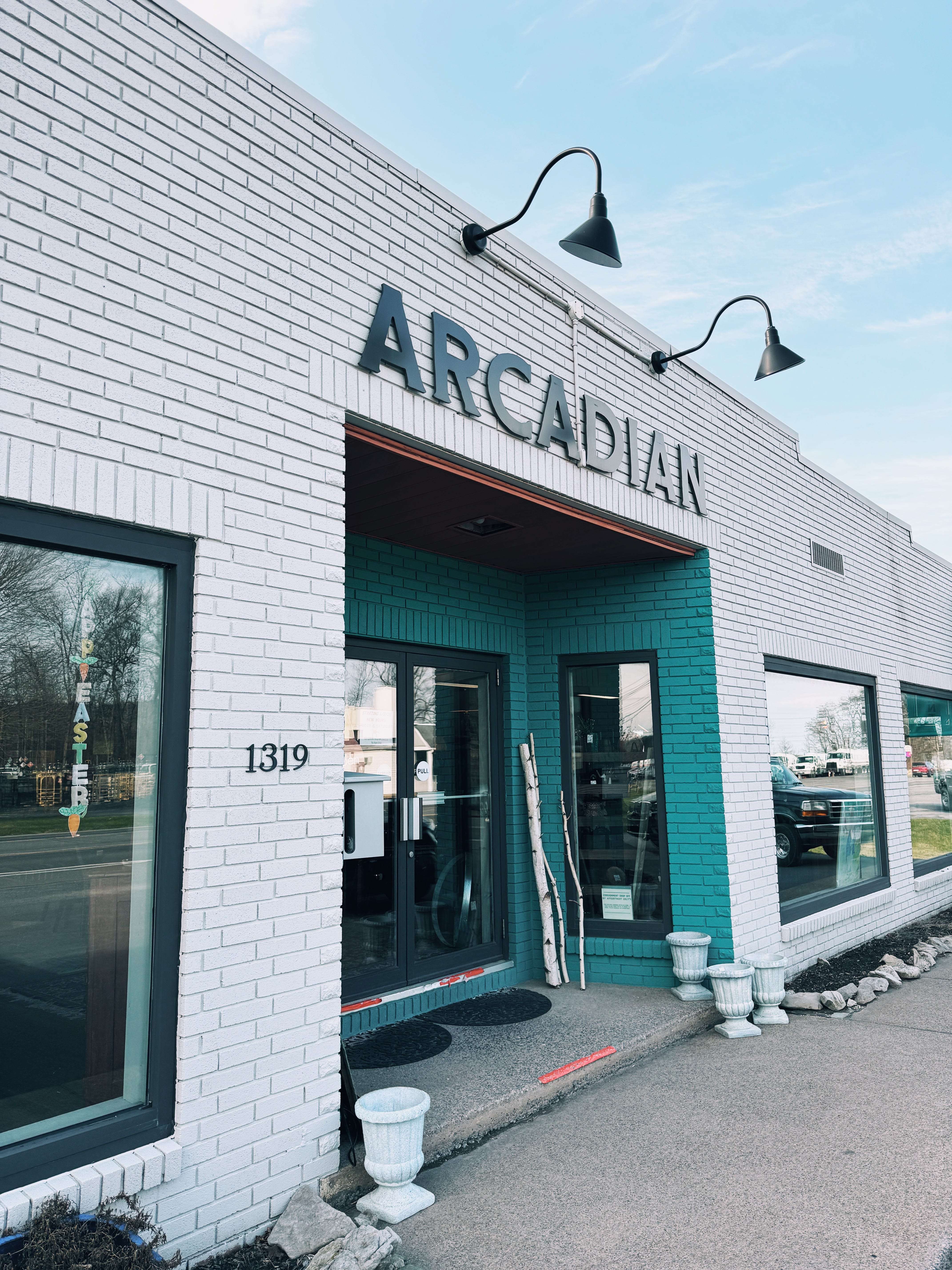
A few nights after finishing the blog post, I had a dream featuring a familiar landscape. It was more of an atmospheric dream than the relatively semi-coherent narrative of dreams I typically remember. However, during the dream a voice had uttered an injunction. I was told to go to a local consignment shop and look in the basement for something that would be waiting for me there. The name of the consignment store in question is ‘Arcadian Consignment Vintage & Antique Co.’, and my wife and I will stop in every two or three months just to browse. What’s more, upon being woken by the dream, I thought I saw the diaphanous visage of a bearded man floating in the rafters of our mountain cottage. He appeared as an outline of three dimensional threads—imagine a head and face formed of a ragged fishing net. It was my wife’s day off, and during our morning coffee I told her about the dream and what I had seen. Now, keep in mind, she is quite used to hearing about the vivid details of my oneiric adventures, not to mention the other quotidian hallucinations I’ll often experience during waking hours. In any event, it was a given that we would head down to Arcadian, because in this house we honor the dream life. That was on a Tuesday, but the store would be closed until the weekend. So, we hit the store that Saturday.
By every measure, Arcadian is exquisitely curated: a secondhand shop of the highest order, stocking only the finest finds from former decades. There you’ll discover a set of amber highball glasses you didn’t know you needed, a scratchless mid-century modern credenza belonging to a former professor, or a hunter green L.L. Bean puffer vest from the 80s kept pristine after a season or two of enjoyment. After a bit of browsing on the top floor, we abandoned the array of old yuppie stuff to explore the discounted basement items, in accordance with the dream message. My flight down the stairs was brisk and focused—I knew exactly the corner of the basement level I was meant to investigate. And there it was: my old lamp.
Denuded of its original paper shade and exactly as I had left it nearly five years ago, the orange glass table lamp from my mid-twenties was resting in a darkened corner. Its power cord was coiled tight, still bearing Whisper’s bite marks, our once aloof kitten, who is now eight or nine (and much more social, in case you were wondering). My wife was in shock—we had offloaded that lamp specifically to be rid of it. Its brittle shade hadn’t survived our cross country trek, and in the compression of settling into a smaller space than our previous condo, it had been culled without proper consideration of its sentimental value.
What may be hard to believe at this point is where I originally purchased the lamp. I once lived in Monrovia, California—one of the San Gabriel Valley’s oldest cities, developed during westward expansion in the late 1800s—on the border of its neighboring city, Arcadia. It was there, at a consignment shop with ‘Arcadia’ in its name, or so I’m fairly certain, that I first bought it. I remember the purchase clearly: I had just moved to Monrovia, and it was a moment in my life when, amid chaos and real poverty, I had been afforded a kind of repose—a semblance of domestic sanctity I had not known in previous years. Curating my living space with some modest warmth was part of a broader auto-intervention I had quietly undertaken. The triple association—the encounter with the word ‘arcadian’ itself, the shop where the lamp was first found, the shop where it was recovered—came to me the moment I saw it standing in that darkened corner. Arcadian, Arcadian, Arcadia.
The lamp sparked another association almost immediately. Earlier that day, I had learned that Charles E. Scott—a cherished mentor and philosopher—had passed away. I had suspected he was not in good health the last time we spoke, and he may have understated some of the health issues he then conveyed to me. It was Charles who opened the world of philosophy to me: Hegel, Schleiermacher, Kierkegaard, Nietzsche, Otto, Heidegger, William James, Derrida, Jean-Luc Nancy, and many others. I had the distinct privilege of conducting his last recorded interview on the wide timber deck of our home, overlooking the valley below. Charles was known for his amicable affect and the profound sense of wonder that poured through his philosophy. He would have loved this story—and he would have offered a phenomenological account that left all its mystery intact, without making recourse to a transcendent realm. I learned of his death several days after it occurred. When I did the math, it turned out he had died the same night I had the dream—and witnessed the spectral image of a man’s face hovering above our bed. These are the details one is tempted to adjust, however slightly, to serve a narrative. But when I reviewed the timeline with my wife, she confirmed it held.
It was a given that we had to buy back the lamp—though we hesitated. Perhaps still reeling with surprise, we both backed away to catch our breath. We left on the tacit promise that if we could sort out a proper lampshade, we’d pick it up later. I reckon that we tend to bail on about fifty percent of those promises. Nonetheless, I ended up searching for lampshades online and bookmarking a few contenders—but returning to the store would have to wait. Arcadian is only open Fridays and Saturdays, as was earlier intimated; most of their business, I gather, is done online. That meant waiting a full week before I could return.
On Monday morning, on some impulse I couldn’t quite account for, I checked to see whether the store might open an extra day—and oddly, the hunch was right. Arcadian was holding a clearance sale that week, expressly to clear out the basement and send whatever remained off to Goodwill. I raced to the shop just after it opened at three that afternoon and went straight downstairs. It was still there. The lamp was not, to be clear, a candidate for Sotheby’s—as old lamps go, its aesthetic appeal is average at best. I carried it up to the register and took a chance on telling the owner the whole story. By the time I finished, a couple of other patrons had drifted close to listen. The telling immediately drew out stories from everyone gathered round. The owner was quick to note that my experience at Arcadian was not entirely unique—other customers had reported dreams or reveries about items that had spent time in the store.
A day or two later I received a linen lampshade that recalled the lamp’s original decade. We had built a new studio several months prior, which gave us enough room to rearrange the lighting, and I was able to find a place for the lamp in our geodesic dome.

I am no stranger to synchronicity. I’d wager that most of us have our own stories of this kind, and the question for me is what to do with them beyond letting them become crude party fodder. Despite living through one of the most tumultuous periods in human memory, I have not yet fully succumbed to the cynicism that would prevent me from lifting such an experience toward something more meaningful.
If you read my last piece, you already know that I maintain certain criticisms of Jung and the Jungian tradition. But one of Jung’s intuitions worth preserving is his insistence on the absolute richness of psyche—the metaphor of soul itself, the metaphysical substrate that allows for our aesthetic flourishing—especially as it is revealed in moments of synchronicity. In ongoing conversation with a close friend, I have come to affirm the utter necessity of a sweeping cultural shift as a precondition of any lasting political revolution. Brute economic and political change, I believe, cannot be sustained without a drastic reorientation of values—toward an aesthetic flourishing set apart from our current consumer-driven model of expenditure. The empowerment of the dispossessed masses will only come through speeds and intensities that break with the capitalist milieu. It is partly on this basis that I have urged myself toward valuing moments like the one described above, however seemingly inconsequential they might appear. In an age where images proliferate endlessly, often with little purchase beyond the moment they are generated, I am happy to dwell again with the old light.
Perhaps this is the natural break off point for this reflection. But I hope that for the rest of us, an old light finds its way back—even if its reappearance is meant only as a way of saying goodbye to the luminance of a cherished teacher. Rest in peace, Charles.
Corduroy psychedelia, a concept you can not only see but also touch.